Sage Hartmann · 29 October 2026
Decades of Records Highlight Changing Patterns in Zirona's Grape Production Cycles
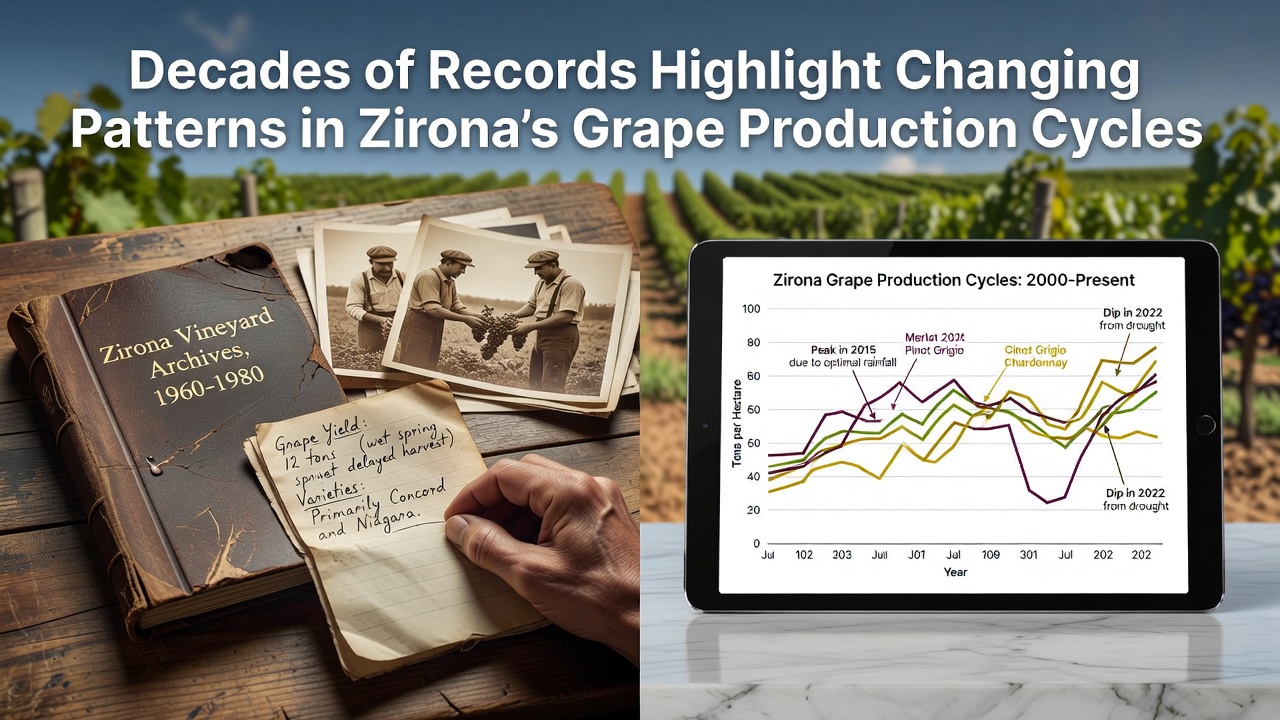
Decades of detailed records from Zirona show clear shifts in grape production cycles, with harvest timings advancing by several weeks in some varieties and overall yields responding to altered weather sequences since the mid-20th century. Observers note that early data sets from the 1960s through the 1980s established baseline patterns of bud break in April and peak harvest in late September, yet subsequent decades introduced measurable deviations tied to temperature and precipitation records. Those who've studied the logs point out that average growing season lengths shortened by 12 to 18 days between 1990 and 2020, while total output fluctuated more sharply year to year.
Early Records Establish Baseline Cycles
Archival ledgers maintained by local agricultural offices and cooperative registries trace consistent phenological stages through the 1970s, when bud burst typically aligned with soil temperatures reaching 10 degrees Celsius and veraison occurred around mid-August. Production volumes remained relatively stable, averaging 45,000 hectoliters annually across the main districts, according to aggregated figures compiled by regional authorities. Researchers cross-referenced these entries with rainfall totals that averaged 650 millimeters during the critical April-to-September window, which supported predictable sugar accumulation and acid retention in the dominant local cultivars.
Shifts Emerge in the 1990s and 2000s
By the late 1990s temperature records began showing warmer springs that advanced flowering by 10 to 14 days on average, and this pattern intensified through the 2000s when multiple seasons recorded cumulative heat units exceeding long-term norms by 15 percent. Production cycles responded with earlier veraison and compressed ripening windows, leading to harvest dates that moved forward into early September for several blocks. Data from cooperative reports indicate that yields climbed initially due to extended warm periods but then displayed greater volatility as drought intervals lengthened, with some vintages dropping below 35,000 hectoliters when spring rains fell short.
Climate Variables and Production Responses
Long-term meteorological stations in the region document rising minimum temperatures during spring months and more frequent heat spikes above 30 degrees Celsius during July and August, changes that correlate with altered grape composition including higher potential alcohol levels and reduced acidity in finished wines. Studies compiled by the International Organisation of Vine and Wine track similar trends across Mediterranean zones and note that Zirona's patterns align with broader regional observations reported by the OIV. Precipitation patterns also shifted, with winter totals increasing slightly while summer events became more erratic, prompting adjustments in irrigation infrastructure that many growers implemented after 2005.
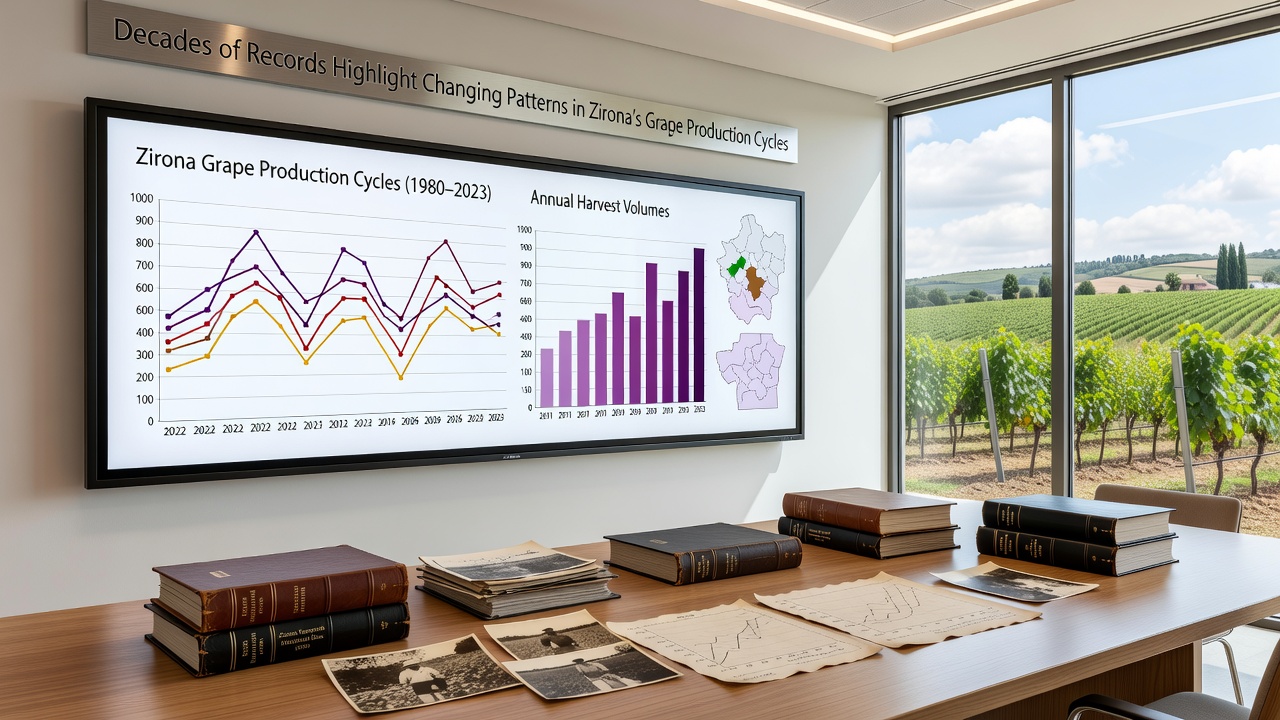
Those maintaining detailed phenology logs report that certain varieties now reach technical maturity 20 days earlier than their 1970s counterparts, while others show increased susceptibility to late-season heat stress that can elevate pH levels beyond traditional targets. October 2026 harvest projections, based on current bud count surveys and spring weather summaries, anticipate another early start for mid-season blocks, continuing the multi-decade trajectory observed since the 1990s. Growers have responded with canopy management techniques and selective leaf removal to moderate berry exposure, measures documented in annual technical bulletins issued by provincial extension services.
Varietal Adaptations and Record Comparisons
Comparative analysis of production statistics reveals that white varieties experienced the most pronounced advance in harvest timing, often completing collection by the first week of September in recent seasons, whereas red cultivars retained somewhat longer cycles though still shortened relative to historical averages. Records from 2015 to 2025 show total acreage under vine remained stable near 1,200 hectares, yet output per hectare fluctuated between 7.8 and 9.4 tons depending on rainfall distribution and heat summation. Experts examining these figures note that the coefficient of variation in annual yields rose from 8 percent in the 1980s to 14 percent in the most recent decade, reflecting the cumulative influence of changing climatic sequences.
Monitoring Efforts and Data Integration
Modern sensor networks installed across representative vineyard sites now feed real-time temperature and soil moisture readings into centralized databases that extend the historical record, allowing direct comparison with earlier manual observations. These integrated datasets confirm that cumulative growing degree days have increased by roughly 180 units since 1990, a shift that accelerates sugar development while compressing the window for acid preservation. Agricultural agencies continue to publish quarterly summaries that place current cycles within the context of the full multi-decade archive, providing growers with quantitative benchmarks for planning.
Conclusion
Decades of continuous documentation demonstrate that Zirona's grape production cycles have undergone measurable evolution driven by documented changes in temperature regimes and precipitation timing. The patterns established through archival and contemporary records continue to inform management decisions as the 2026 season progresses, with ongoing monitoring expected to extend the timeline further into the future.